
154 Brigade - Operation Plunder - The Crossing of the Rhine
March 1945
154 BRIGADE OPERATIONS
Rhine Crossing
Extract from 154 Brigade History
The task allotted to the Brigade involved an assault crossing over the river followed by an advance inland of about five thousand yards on a two mile front, all to be carried out at night. It was appreciated that this was a very formidable task and would require at least four Battalions to complete it and might possibly also require the assistance of the remainder of the Canadian Brigade which, as stated, was to be held available for this purpose.
During preliminary reconnaissance of the ground and river carried out by commanders and staff officers, it was possible to obtain excellent observation over the river itself, and the ground beyond, from houses and church towers near the west bank of the river and from the bund on the actual bank of the river itself.
The ground on the far bank was extremely flat and open for a few miles and the dominating features were obviously the buildings and small hamlets which lay astride the various roads. From a close examination of all types of air photographs and very large scale maps, and comparison of these with the ground as seen on reconnaissance, the two points for crossing the river on the Brigade front were selected and the Brigade plan was built up.
The Brigade plan for the operation was divided into five phases.
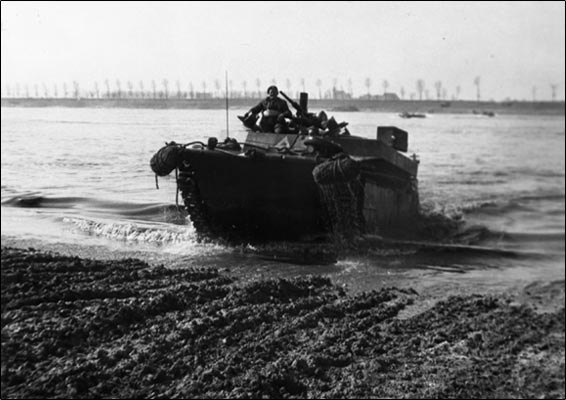
A Buffalo comes ashore, Rhine, 1945
show infoDescription:
1st Black Watch, Buffalo comes ashore.
Copyright:
Black Watch Museum
Tags:
First Phase. -Two battalions - 7th Argylls on the right and 7th Black Watch on the left-were to cross at the selected places and capture the area from Wardmannshof on the left to Krugshoven (a small hamlet near the inter-Brigade boundary with 153 Brigade) on the right.
Second Phase.-As it is extremely important in operations of this nature to get as many troops as possible landed on the far bank as quickly as possible before the enemy recovers from the preliminary artillery bombardment and starts taking counter measures, 1st Black Watch were to cross almost immediately after 7th Argylls and at the same place, and were to pass through the Argylls' bridgehead and capture KI Esserden and Speldrop, the latter of which lies across the main road running north from Rees which would obviously be the route used by enemy reinforcements.
Third Phase.-Whenever 1st Black Watch had passed through 7th Argylls the latter Battalion was to reorganise immediately and get ready to pass through 1st Black Watch on completion of that Battalion's task, and to capture Bienen.
Fourth Phase.-7th Black Watch were to continue their advance northwards to Grieter-Busch.
Fifth Phase.-The H.L.I. of Canada were to launch an attack against Millingen which would be followed by the deployment of the remainder of the Canadian Brigade.
The artillery support for the operation was on a tremendous scale and was designed to neutralise the enemy defences near the river, their gun lines and all possible routes forward for enemy reinforcements.
The problem of providing tank support for the Infantry on the far bank before bridges could be built across the river was met by the provision of D.D. tanks, i.e. tanks fitted with a special swimming device which enabled them to cross the river under their own propulsion. A squadron of the Staffordshire Yeomanry, equipped with these swimming D.D. tanks, was put under command of the Brigade for the operation.
The Brigade was also allotted an Air Tentacle equipped with direct wireless communications to fighter/bomber aircraft so that close air support could be called for at any time. A certain number of this type of aircraft were to remain in the air all the time in order to provide immediate and continuous air support on what was termed the "cab rank" principle of air support.
It was estimated that it might be two or three days before bridges across the Rhine would be functioning and it would accordingly be necessary during that time to rely entirely on pontoon rafts and Buffaloes for ferrying over essential transport, supporting arms, ammunition and supplies. All vehicles, etc., were pre-loaded and given serial numbers and a priority list was prepared so that the vehicles, etc., could be sent over the river in the order in which they were required and called for by the Battalions on the far side. Special wireless communications were provided, on a Corps basis, to enable this system to be as flexible as possible and to ensure that any vehicle required by the bridgehead troops could be called for and sent across without delay.
By 21st March all necessary preparations had been made and all orders issued and the Brigade moved from Holland into Germany and into its allotted place in the Divisional marshalling area between Calcar and the Rhine. The next two days were spent, behind and under cover of a continuous smoke screen laid along the west bank of the river, in loading and marshalling into their assembly areas the large number of vehicles which would be required in connection with the operation and in briefing, in great detail, all the troops which were to take part in the operation under Brigade command.
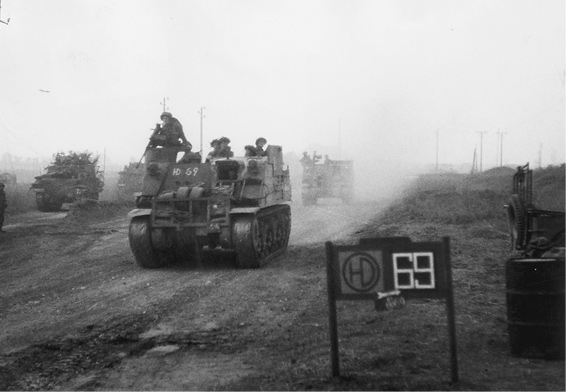
Black Watch and Kangaroo
show infoDescription:
On the night of 23rd March 1945 men of the three Black Watch battalions in the 51st Highland Division were ferried across the Rhine under cover of artillery barrage and a massive smoke screen. They are seen here moving forward in 'Kangaroos'. The HD 69 signifies the 7th Battalion. Little opposition was met before they were established on the far bank. The credit for being the first British troops across the Rhine fell to this battalion. The term 'Kangaroo' was applied to converted tanks and gun platforms like the hulls of Shermans and Priests which were converted into infantry armoured personal carries from Normandy onwards.
Copyright:
Queens Own Highlanders Museum
Tags:
At 18.00 hours on 23rd March Brigade headquarters was established in Honnopel a few hundred yards from the river bank, and by this time the preliminary bombardment of the enemy positions and gun lines had started. At 20.30 hours the Buffaloes, loaded with the two assault Battalions, began -moving forward towards the river from their assembly areas about half a mile back along previously selected and marked routes, and at Zero hour (21.00 hours) the Buffaloes carrying the leading companies of the assault Battalions entered the water.
Within six minutes (21.06 hours) reports reached Brigade headquarters that the leading companies of both Battalions had landed on the far bank and that the assault was going exactly as planned. A message of congratulations was received from the Corps Commander stating that 7th Black Watch were the first Allied troops to land on the far bank. By 23.00 hours both assault Battalions appeared to be getting on well and had taken most of their objectives, although isolated fighting was still going on, particularly in the 7th Black Watch sector. By this time both assault Battalions had -called for their essential fighting transport to be sent across the river and 1st Black Watch had almost completed their assembly on the far bank.
At midnight 1st Black Watch passed through 7th Argylls and by 02.30 hours on 24th March reported the capture of their first objective by their right forward company although their left forward company was still meeting very strong opposition at KI Esserden. A third company had been passed through on the right towards Speldrop and by 05.00 hours this company had almost completed its task although the rest of the Battalion wer'e still fighting for KI Esserden. Unfortunately at this stage Major R. Boyle, M.C., commanding the leading company, was killed. Before joining 1st Black Watch, a short time before the landing in Normandy, Major Boyle had seen much fighting with 2nd Black Watch in the Middle East.
Shortly after 06.00 hours 1st Black Watch reported that a strong counter-attack by enemy tanks and infantry had developed on Speldrop which had only been partially cleared of the enemy by this time, but that Kl Esslerden had now been captured. The situation in Speldrop further deteriorated and communications with the company there broke down completely.
Meanwhile 7th Black Watch had captured Kivitt and a counter-attack against them had been successfully repulsed. By 07.30 hours 7th Black Watch were firmly established in their area.
The D.D. tanks had been unfortunate in the landing beach allotted to them, which had proved to be unsuitable, with the result that by 08.00 hours only six tanks of the squadron had managed to extricate themselves from the river and half of these had already been committed with 1st Black Watch.
Brigade headquarters had been established on the far side of the river since 05.00 hours and the Brigade Commander, after visiting 1st Black Watch, ordered them to launch a further attack on Speldrop to join up with what remained of the right forward company which had now become isolated there. This attack started at 10.30 hours and was strenuously opposed by the enemy with S.P. guns and tanks. By 11.50 hours 1st Black Watch reported that they were in Speldrop and that, although the opposition was still very strong, they could hold on if more tanks could be got forward to support them quickly. All the tanks of the troop sent forward earlier to support the Battalion had already been knocked out while attempting to move forward to Spe1drop during the attack on it. Further attempts were now made to get some more tanks forward to Speldrop but had to be abandoned as all possible approaches· were mined or covered by enemy anti-tank guns. 1st Black Watch had been unable to gain contact with their who had reached Speldrap earlier in the morning and, as ammunition was running short and the Battalion had already suffered heavy casualties, the Brigade Commander ordered them to withdraw so that another attack could be launched with a fresh Battalion.
In the confused fighting which had taken place, it had been impossible to get everyone out of Speldrop when 1st Black Watch withdrew from it and elements a second platoon were cut off and had been left in the village. When Speldrop was re-taken in the late evening, it was found that the few survivors of the cut-off platoons were still holding out gallantly under Lieut. R. J. Henderson and had inflicted heavy casualties on the enemy throughout the day and prevented any enemy reinforcements using the main road to Rees where heavy fighting was taking place in the 153 Brigade.
Citation for the D.S.O. awarded to Lieut. R. J. Henderson, 1st Black Watch, in recognition of gallant and distinguished service during Operation Plunder, March 1945.
During the morning the Argylls had been passed through the left of 1st Black Watch sector and their advance from Kl Esserden towards Bienen had been making considerable progress throughout the day against determined resistance. By 16.00 hours they had reached the southern approaches of Bienen and stiff fighting went on in the Battalion area for the remainder of the day.
During the day the Division suffered a very heavy loss when its Commander, Major General T. G. Rennie, CB., D.S.O., M.B.E., was killed by a shell soon after leaving 154 Brigade headquarters. General Rennie had proved himself be a magnificent Divisional Commander and was, in every way, a worthy successor to General D. N. Wimberley who had commanded the Division with such distinction in North Africa and Sicily. General Rennie was an ex-Commander 154 Brigade, having commanded it during the latter part f the North African campaign and also in Sicily. An appreciation which the Brigade Commander, who had served under General Rennie when the latter was a CO., Brigade Commander and Divisional Commander, wrote for "The Times" about General Rennie is included as Part 3 of this chapter.
General Rennie was succeeded in command of the Division by Major General G. H. A. MacMillan, CB., CRE., D.S.O., M.C, who had commanded 152 Brigade in the Sicilian campaign before being appointed to command 15th Scottish Division, with whom he had been wounded in the early stages of the campaign in Normandy.
The H.L.I. of Canada had crossed the river, under Brigade command, during the morning and had since been held in reserve near the river bank. When the attack by 1st Black Watch against Speldrop was unsuccessful far a second time, the Brigade Commander decided to use the H.L.I. of Canada in a full scale deliberate attack against Speldrop, strongly supported by as much artillery as could be made available. This attack was launched in the late evening, behind a very heavy artillery barrage, and the Canadians made good progress. By midnight they had captured Bienen and had linked up with the remnants of the platoons 1st Black Watch still holding out there.
During the night 24th/25th March, 7th Black Watch were relieved by a Battalion of 9th Canadian Infantry Brigade and came into Brigade reserve. At 05.00 hours an 25th March the Argylls were heavily counter-attacked south of Bienen but by 06.30 hours this attack had been successfully beaten off.
During 25th March the Brigade was relieved of its responsibilities in its sector by 9th Canadian Infantry Brigade, as it had been decided that the Corps thrust northwards would now be made on a two Division front with 51st Division on the right, in the Rees sector, and another Division on the left in the area where 154 Brigade had been operating.
2. FINAL PHASES OF OPERATION "PLUNDER"
25th March 1945 to 30th March 1945
153 BRIGADE had been successful in establishing its bridgehead around Rees and 152 Brigade had been passed through them and had advanced northwards on the axis of the Rees-Isselburg road. As all battalions of both these Brigades were fully employed holding the perimeter of the bridgehead, 154 Brigade was ordered to open up the Divisional axis leading out of the bridgehead towards Isselburg and was given the immediate task of clearing all enemy from the south side of a small stream which flows through Empel on the main road to Isselburg. If the enemy opposed the crossing over this obstacle, arrangements were then to be made for the Brigade to force a crossing over it the following night, by which time another Brigade would be ready to pass through 154 Brigade's bridgehead and continue the Divisional advance northwards.
The attack commenced at 22.00 hours on 25th March, 7th Black Watch being given the initial task of closing up to the water obstacle at Empel and, if possible, of seizing the bridge there if it was still intact. 1st Black Watch was held in readiness to pass through 7th Black Watch if the bridge was captured and it appeared that the bridgehead could be established that night. Very considerable artillery support was provided and initially the attack went very well.
By 23.30 hours 7th Black Watch were up to the water obstacle and had ascertained that the bridge was intact. One company was ordered to cross the bridge with a view to establishing a small bridgehead on the far side, but immediately it started to cross it met, at close range, extremely heavy and accurate small arms fire from the village of Empel and was also shelled and mortared and suffered severe casualties. Little progress was made and at 01.30 hours on 26th March the Brigade Commander ordered 7th Black Watch to cease their attempts to force a crossing that night and if possible to prevent the bridge from being blown by keeping it covered at close range from the south side.
7th Black Watch had suffered fairly heavy casualties in this engagement but they held their positions on the south side of the stream firmly although in very close contact with the enemy across the stream, who appeared to be holding the far bank in considerable strength. On the following night, when a bridgehead across the stream was established, one officer and fifteen other ranks, nine of whom were wounded, belonging to the company of 7th Black Watch which had attempted to force a crossing over the bridge, were found to be holding out in a house on the far bank and from which they had, for almost twenty-four hours, prevented German sappers from getting to the bridge in order to demolish it.
During 26th March any movement in the Empel area caused heavy enemy shelling and mortaring, and the enemy appeared to be very sensitive to any further advance being made along the axis of the Isselburg road. Throughout the day the enemy in the sector were given no rest and the slightest movement on their part was rewarded by heavy shelling by the Divisional artillery. Much use was made"of the Air Tentacle and about twenty targets were taken on, the majority being in close support of 7th Black Watch. A most remarkable performance by Typhoon rocket aircraft, which were carrying out the tasks called for by the Brigade, was a successful attack on an enemy S.P. gun sited only about 300 yards from the forward troops of 7th Black Watch.
It was believed that the enemy had opened the dam gates in the upper Rhine in an effort to make the Allied bridging and ferrying tasks more difficult and this had caused a considerable amount of temporary flooding in all the water ways in the district, including the stream at Empel. The Brigade' Commander accordingly decided that it would be necessary to use Buffaloes for the crossing of the stream and he decided that the crossing should be made to the east of the village where the approaches appeared to be more suitable than on the west side of the village. At the same time as the Brigade was to be making the assault crossing 43rd Division, on the left,. was to capture Millingen and advance eastwards to join up with 154 Brigade. 1st Black Watch were ordered to carry out the initial phase of the crossing and to capture the village of Empel and to join up with 43rd Division on the Empel-Millingen road. 7th Argylls were to cross immediately after 1st Black Watch, in order to enlarge the bridgehead and provide protection for the right flank while the route forward through Empel was being opened up to allow another Brigade to pass through.
The attack commenced at 21.00 hours on 26th March and the Brigade once again received excellent support and assistance from the Northamptonshire Yeomanry which provided and manned the Buffaloes used for the crossing. By 22.30 hours 1st Black Watch reported that they had captured Empe1 and that the bridge was still intact. At 23.00 hours 7th Argylls crossed, also in Buffaloes, and reached their objectives without much opposition. 1st Black Watch had considerable difficulty in dealing with three enemy S:P. guns in the area of the railway station at Empel. Shortly after midnight these guns attempted to make a dash northwards through the 7th Argylls position, but they were successfully engaged with PlATs. The following day all three guns were found knocked out and abandoned about a mile further north. By 02.00 hours on 27th March both Battalions had completed mopping up and were firm on their objectives. A considerable number of prisoners had been captured by both Battalions.
During the next two days the Brigade had an opportunity to reorganise and absorb its reinforcements while 152 and 153 Brigades developed the Divisional axis to and beyond Isselburg. About mid-day on 29th March the Brigade Commander was ordered to make a Brigade attack that night in order to capture the town of Dinxperlo with the object of opening up the roads leading north and north-east out of the town to enable the Guards Armoured Division to deploy and develop the Corps thrust northwards.
It was not believed that the enemy were holding Dinxperlo in any great strength but thorough planning was carried out for the Brigade attack. The attack was launched at 21.00 hours, all three Battalions taking part, and the town was captured with very little opposition, although some casualties were sustained from enemy shelling and mines.
At 06.00 hours on 30th March the Guards Armoured Division passed through the Brigade and began its advance northwards. Later in the day the Brigade was ordered to send out an infantry covering party to assist some tanks which had become ambushed by some German infantry armed with anti-tank grenades, and 7th Argylls detailed a company to carry out this task. Unfortunately, in completing this task, the Battalion lost one of the finest company commanders it ever had, Major . F. Corcoran, D.S.O., M.C., who was badly wounded.
By the evening of 30th March the Guards Armoured Division were reported to be making good progress and the Brigade became non-operational.
Division History References :
The Operation to cross the Rhine was to be called Operation Plunder. The Plan for Operation Plunder was to cross on a two corps front with 51st Highland division on the left leading 30 Corps. The Divisional objectives on the other side of the Rhine were Honnepel and Rees.