
Notes on Battle of El Alamein
North Africa, 1942
Notes on the Battle of El Alamein from the 7th BN Argyll and Sutherland Highlanders.
Although the place and date and even the probability of a night attack were kept as closely guarded secrets, it gradually became obvious that something of the kind must be afoot. In the month before the battle we took part in five full scale rehearsals, all slightly different, but all of approximately the same operation. Finally, during our spell in the sector of the front a little south of TEL EL EISA station which the three brigades held in turn, we were ordered to dig and camouflage slit trenches for the whole battalion about a mile behind the front line, nominally as a new defensive position, actually for our assembly area before the attack.
On 21st October the plan was divulged, an attack on the whole Army front with the main breakthrough for the Armour to be made in the North on the Alamein sector by the Australians (right), Highland (Centre) and New Zealand (Left) Divisions. Zero 2200hrs 23rd October 1942. During the night 22/23 Oct we moved forward into the assembly area and occupied the trenches we had dug. Everyone had his own food and water and his own trench to go to and the order was to lie hidden throughout the hours of daylight. It was a tedious day, but the manoeuvre was successful, and apparently undetected by the enemy, which was lucky as the whole area was crammed with hidden troops and guns and a day of intensive shelling or bombing would have been costly and a bad start to the battle. Actually not even a Stuka came over.
The transport meanwhile was being moved into its proper places for the battle. The most important was the A.1 Echelon which was to follow the Battalion's advance, led by a line of lights which we dropped as we went forward, as quickly as the Sappers could clear the gaps through the minefields, and was to be up in time to assist in the reorganisation of the final objective in readiness to meet the counter-attack which was expected at dawn on the 24th. It consisted of anti-tank guns, R.A. and our own Machine Guns, Mortars, R.E. Stores (mines etc) Signal Stores, Medical Stores, etc: and the Bren Carriers which did maid-of- work, carrying the reserve ammunition and tools for the rifle coys and at the same time towing Anti Tank two pounders. They did the job well but it was too much for them and eventually led to breakdowns.
Dark came about 7 o'clock on the 23rd and the assembly area then came to life. Everyone emerged from his hole, water bottles were filled, a hot meal was issued from three cook's trucks which had filtered forward at long intervals during the afternoon and final preparations were made. Each man wore a white St Andrew's cross on his back, every other one carried in addition his rifle a pick or a shovel ( this for the all important re-organisation) and everyone had a grenade or two in his pocket. At 2030 hours the march to the start line through prepared gaps in our own two minefields and out on to the tape, laid by the 5th Seaforth in No Man's Land as soon as darkness fell began. All went smoothly and by 2145 hours, the time at which the Infantry had to cross the line, the Battalion was formed up ready.
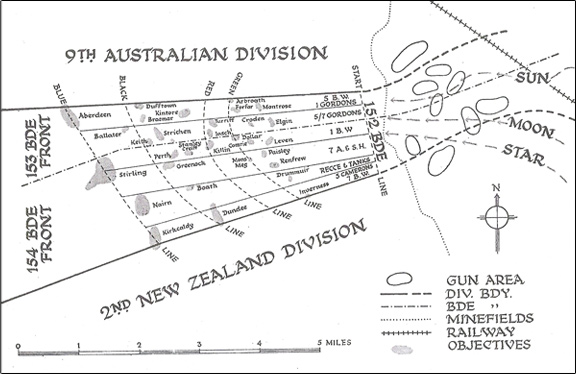
Diagram El Alamein Operations
show infoDescription:
Diagram of the area of operations of 152 Brigade at El Alamein, North Africa, October 1942.
Tags:
The Corps objectives were four lines to be captured in turn, The Green Line, The Red Line, The Black Line and The Blue Line. The attack was supported on a timed programme by tremendous artillery concentration on known or suspected enemy positions and the job of the Infantry was to keep up close behind this barrage, walk through and minefields met and deal with all the enemy localities concerned. The lines were more or less arbitrary and did not necessarily represent actual objectives on any particular battalion's front, but as they were Corps lines and used as the basis of the timing of the artillery programme careful pacing had to be done to know when they were reached and when it was time for the pauses on them to be observed.
The Division attacked with 153 and 154 Bdes. up. We had the 42nd on our right and the 51 Div Recce Regt and a sgn of tanks theoretically on out left (actually mines held them up to a great extent and their "lane" was not properly cleared until later) and beyond them the 7th B.W. We and the 1st Gordons alone had objectives on the Blue Line, a distance of about 4 1/2 miles. Ours a locality names STIRLING looked a formidable proposition to take on at the end of so long as advance with other smaller localities to be captures on the way, and actually we never reached it, which was, as events proved, probably just as well. But it considerably influenced our plan as one had to think all the time of how to keep enough fresh troops on hand to tackle this tough nut at the end. Air photos showed it as containing nine anti-tank guns, including two 88 cm. and thirty machine guns. Apart from that our lane was not expected to be strongly held by men, but it went straight into one of two "pockets" which Intelligence reports had already pointed out on the enemy front suggesting that they were intended to lure troops into as good "killing grounds": and such our one turned out to be. It was full of unsuspected mines, both anti-tank and anti-personnel, and was most effectively swept by artillery and a certain amount of machine gun fire. The infantry localities in it were called PAISLEY, RENFREW, MONS MEG, FALKIRK, GREENOCK, and finally STIRLING.
We attacked with two Coys forward, "C" Coy (Major J. S. LINDSAY-MACDOUGALL) on the right, "D" Coy (Capt. D. BUCHANAN) on the left. "B" Coy (Capt. J. C. MEIKLEJOHN) RIGHT, Bn H.Q. centre, and one Platoon of "A" Coy under Capt. J. L. ROBERTSON followed five hundred yards in the rear. The remainder of "A" Coy (Capt. G. B. HORSBURGH) had been detached and were travelling on the Tanks of "C" Sgn 50th Royal Tank Regt. The plan was for "C" and "D" Coys to capture all objectives up to the Black Line, where they were to re-organise and for "B" Coy then to pass through them, and "A" Coy and the tanks, which should by then have cleared the minefields and come up with the Battalion, to capture STIRLING. The spare Platoon of "A" Coy were to act as moppers up on the left front during the advance and to come under command of "D" Coy for the attack on STIRLING. I did not like the idea of "A" Coy going off with the tanks from the start and would far prefer to have been allowed to keep them with me. I felt doubtful of the tanks ever reaching us in the dark and sooner than let the bulk of "A" Coy go off and run the risk of getting lost with them would have preferred to keep "A" Coy with me and taken the chance of having to attack STIRLING without tanks. As it turned out the tanks did fail to reach us and "A" Coy were only able to rejoin us two days later.
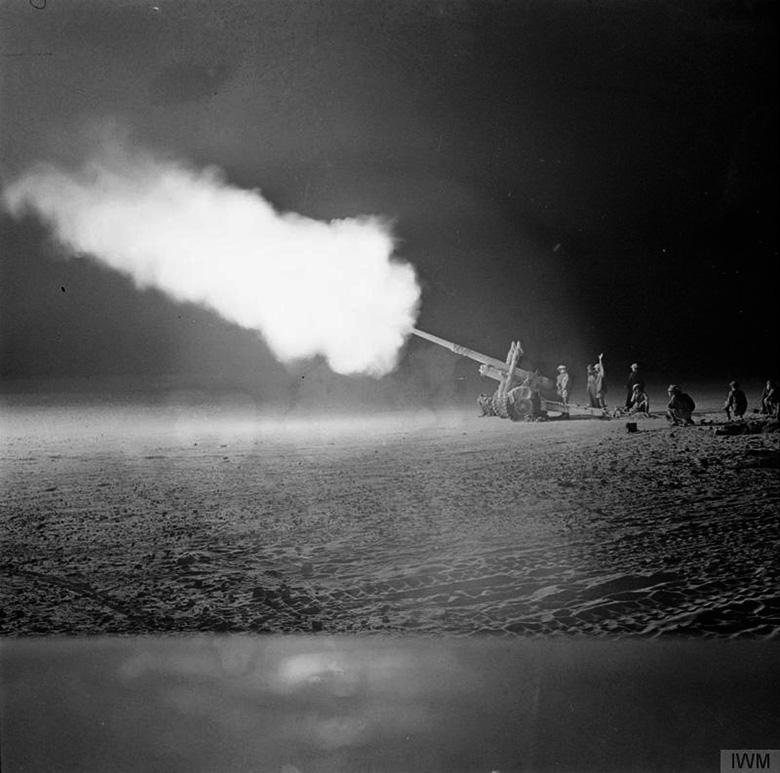
4.5 inch gun, El Alamein
show infoDescription:
4.5 inch field gun firing at night at El Alamein
Copyright:
IWM (E 14775)
Tags:
At 2140 hrs, our artillery opened twenty minutes counter battery work. At 2145 hrs the infantry crossed the start line, peacefully except for the sound of our own guns. At 2200 hrs, zero hour, the artillery began their programme on the enemy localities. What happened after that is hard to describe. The advance continued with one pause of an hour and two of fifteen minutes, during which the movement stopped but not the fire, for approximately five hours. For the whole time the noise was terrific, and smoke, sand and the smell of cordite everywhere. There were minefields to be walked through with care, tripwires attached to anti-personnel mines to the stepped over gingerly (our losses of leaders were probably due partly to them), enemy posts to be attacked and cleared, and over all the colossal din and shells bursting everywhere. The least nice of the number of varied projectiles launched at us was a large affair which burst about thirty feet from the ground with a tremendous flame and shower of sparks. There were also things rather like Chinese Crackers which hoped along the ground banging as they went. But the men were simply marvellous. None of them, even those who had been in France or elsewhere, had ever experienced anything like it before and for most it was their first taste of battle, but they went forward with the Company Pipers playing as steadily as they did in the rehearsals. Casualties were heavy, the heaviest in the Brigade, it not in the Division, but every enemy post was mopped up and very few prisoners were taken. Everyone did his job, the formation was maintained and the attack was steady.
In the turmoil where all did well it was difficult to single out names, but some came in for special notice. Major J.S. LINDSAY"MACDOUGALL, who with a megaphone in one hand and a rifle slung over his shoulder calmly led his Coy through the hottest fire, and gave a magnificent example of cool and courageous leadership, Lieut. A.M. MacVICAR, who, though twice hit, refused to fall out and carried on through the attack and for two days more; Lieut R. MATHIESON, who, hit early in the foot, continued to hobble on though he could hardly walk, until another shell smashed his hand and forced him out of the fight, Lieut. H.D.L. SAMWELL of "D" Coy who after the Coy Comdr was hit took charge and was seen everywhere, leading and encouraging his men; L/C LAKE of "C" Coy who turned out a tower of strength, ready to lead anyone and to carry out any order, and a whole host of others.
Eventually the Black Line was reached with the capture of GREENOCK. I then decided that the attack on STIRLING was not on. "A" Coy and the tanks failed to appear, "C" and "D" Coys were both seriously weakened, the Platoon of "A" Coy under Capt. ROBERTSON had been sent off to strengthen "D" Coy and all I had left was two platoons of "B" Coy. (One platoon had been knocked out almost completely on the way up either by one of the big shells or more probably by one of the booby traps which were found later consisting of one or more 500kg air bombs attached to a trip wire.) Two platoons were not enough to attack so strong a place unsupported and I decided our job was to consolidate the ground we had won. It was disappointing not to complete our task, but as it turned out afterwards what we had done was sufficient to have the name of the 7th Argylls all round the area by the following day.
The total strength available now amounted to about two hundred and with these we dug in under intermittent mortar and machine gun fire. Meanwhile "A" Coy with the tanks had arrived on the 1 B.W. front on our right but too late for the tanks to be able to cooperate. The tanks withdrew after a certain number of them had been knocked out and "A" Coy set off to rejoin the Bn. In this they were unsuccessful, both they and the Rear Bn. H.Q. being caught by daylight in a place from which machine guns prevented any movement. They were heavily mortared and machine guns of the 1/7th Middlesex brought up to help them were knocked out. For some time no communication with them was possible. The Pipe Major (MACLACHLAN) tried to come forward with a message but was killed and Pte. GOLDSMITH sent out to go back to them returned to Bn.H.Q. with his arm smashed. His one anxiety seemed to make it clear that he had tried to get through "but they were shooting at me all the time, and at last they got me".
The situation next morning was not a peasant one. We had been told that a counter attack with tanks was the invariable rule and we were ill prepared to meet it. Apart from our small numbers, no transport, including anti-tank guns, mortars and machine guns had arrived (it turned out afterwards the unexpected depth of the minefields had slowed them down too much to manage it) we had no communication with the Brigade, both wireless sets having failed, and there was no one to be seen anywhere behind us. Altogether we felt rather out in the blue. However, no counter attack came and in the afternoon about four o'clock, all heralded, except for their barrage which opened on Bn H.Q. came the 2nd Seaforths, who pushed out beyond us till stopped by the wire and machine guns of STIRLING and dug in there, so greatly strengthening our position. This daylight attack of theirs, by two Coys was a magnificent and cheering sight and was carried out with the greatest dash and courage. We were given no news of it as we were still completely out of touch with the rear, and it turned out afterwards that owing to the machine gun fire no one was able to get up to us. Later in the evening, as even more cheering sight appeared, the first of our own tanks and with it what become a familiar experience it the next few days, that sitting in the middle of a tank battle and cowering in you trench while the opposing Armour hurled obscenity at one another apparently just above the level of your head. From the day it captured GREENOCK, 24th Oct. to the day it captured TEL EL AQQAQIR, 4th Nov. the battalion was, except for one night, in all its positions always under shell fire, and a good deal of the time under machine gun fire as well.
The casualties were, however, except in the actual attacks, extraordinarily small. In the latter stages the fire, though accurate, must have unobserved. Stuka raids were added when we left the front line, but they were directed at transport rather than troops and did little or no harm.
On Oct 25th orders came that we were to attack NAIRN, a long ridge in front of GREENOCK which provided the enemy with a good O.P. and was strong in anti tank guns and well protected by M.Gs and mortars. The whole direction had now rather swung to the south and STIRLING our original objective, having been attacked by tanks and pounded by guns, was to be taken in a simultaneous attack by the 5th B.W. Both attacks were to start at 2300 hours and both were to be silent, i.e. without artillery support. Our plan for NAIRN was to attack with "A", "B" and "D" Coy, now only about forty strong, and Bn H.Q. to hold the ground already won, in case anything went wrong, and to follow them on to the ridge, a distance of about 1,800 yards, on the success signal. "A" Coy much depleted, arrived back only an hour or two before taking part in the attack. All went well, until unfortunately there was a slight confusion and some noise on one part of the start line which caused one or two of the enemy M.Gs to open up before the troops had left. But all got off all right and the first enemy positions were taken without difficulty. As they neared the second positions however, the attack came under heavy crossing machinegun and mortar fire. "A" Coy suffered especially heavily, all their officers being hit. In spite of this, however, and although they converged rather than diverged as had been intended all the Coys pushed on and cleared every post they came to. A conservative estimate is that sixty or seventy of the enemy were killed. Twenty odd were taken prisoner. From the reports coming in, it looked as if the attack had run into something too strong and a set-back seemed probable. But then came a messages on the wireless from Capt. J.C.MEIKLEJOHN, O.C., "B" Coy to say that he had reached his objective and collected remainder of "A" and "D" Coys to him, giving him about a hundred men in all, and that he was holding on, but that the enemy seemed to had closed in behind him, and to have cut off all communications and to be threatening counter attack. The explanation seems to be that relief of the Italians, whom we had been disappointed to find in front of us in the first attack, by Germans was taking place. All the troops encountered in this attack were Boches. It has come out since that Rommel was not expecting our main push in the north, so he probably thought he could safely leave the northern sector to the Italians but changed his mind later.
Meanwhile the mortar fire shifted on to Bn H.Q. and the transport and anti tank guns which were again waiting for the gaps in the minefields to enable them to get forward. It soon became clear that MEIKLEJOHN was cut off. He reported that he was short of ammunition, so two carriers were sent off to try to find him, but they were unable to find him. Lt.A.J.A.STEWART then set off with the same two carriers, came within heaing distance of MEIKLEJOHN, but could not reach him on account of mines. Lt. F.A.SILLS, who was now the only officer left with MEIKLEJOHN unwounded, came out to try to guide him in but eventually ran into a party of Germans as there was a shout of "Up the Argylls" followed by the sound of grenades, and Lt SILLS had not been seen since. STEWART was to far off to help and MIEKLJOHN's party could not hear what happened. STEWART then returned to Bn H.Q. but set out on another attempt, this time with four carriers, two towing anti tank guns, but this attempt was again a failure and two of the carriers were blown up on the minefields. Daylight stopped further attempts. Meanwhile MEILKEJOHN and Major HUGH FORSTER, 126 Fd Regt R.A., our F.O.O. had been in wireless communication and through his wireless MEIKLEJOHN directed defensive fire which FORESTER put down round his position, thus probably saving him from being over-run. All the next day the position remained the same, further attempts to get ammunition, and now food and water also, through failed and it was only the day after that supplies eventually reached the garrison. All attempts accurately to place their position on the ridge by shell fire, verey light, etc. failed and thought they could see us we could not see them.
When reached they were found not only to be on their objective and in occupation of one and the main positions on NAIRN, but to be in excellent spirits, in spite of their trying experience. The whole thing was a great piece of work on the part of MEIKLEJOHN, who gave a magnificent display of leadership, courage and determination. Rather ironically while I was still swithering about risking my sound base by launching the last party of men of "C" Coy on to a two thousand yard objective, a motorised battalion attached to the tanks came up and occupied it and were the first friends that MEILKEJOHN saw. They left next morning with as little warning as they had come, leaving MEIKLEJOHN in the middle of a full fledged tank battle and still inaccessible.
NAIRN was occupied with "B" and "C" Coys (now Capt. D.E.YOUNG) forward on the ridge and "D" Coy (Capt. A.M.LESLIE) back. For a short time there was also an "H" Coy consisting of spare men of "HQ" Coy, and commanded by Lt. J.H.F. MORTON. MEIKLEJOHN was sent back to the Div. Rest Camp to recuperate and was sent from there to Hospital, and of the original Rifle Coy's Officers, YOUNG was then the only survivor. All the others, except MIEKLEJOHN, having become casualties, all wounded except J.L.GILMOUR killed and F.A.SILLS missing. At this time drafts of officers and men began to arrive, first our own re-inforcements , then from 2nd and 5th Seaforths, 2nd and 5th Camerons, and finally seventy from the 91st, bringing the battalion at the end of the battle to something like full strength again. Officers were still short and several of the newcomers were Cameronians. The four Coys were reformed, command of "A" Coy being given to Capt. G.V.SEYMOUR, R.S.F. The shortage of N.C.Os was a serious problem, so many having been lost in battle, and rapid promotion was inevitable, and in many cases well deserved.
Round the position on NAIRN we laid a complete system of minefields, the anti tank guns and machine guns and mortars were sited and one or two successful mortar shoots were conducted by telephone from observers pushed with two forward platoons over the crest. Shelling and occasional machine gunning, apparently on fixed lines, continued and there were some casualties, but not a great number. At this time the men were being worked pretty hard as they were often shelled very heavily by day and much of the night was spent in patrolling and laying the mine fields, which could not be done in daylight as they were under enemy observation and fire. A fighting patrol was sent out to destroy the most annoying machine gun post, but it was unsuccessful. It started badly as a joint patrol, half Argylls and half 7 B.W. The start was delayed by a threatened counterattack and finally when the patrol got within 30 yards of its objective it met high wire and fire was opened on it from several directions. Both officers were wounded, ours was Lieut. A.S. BOWDEN, and his patrol withdrew, Pte. SHIELDS carrying a wounded comrade all the way back to our lines. A reconnaissance patrol to discover the position of another M.G. post, which it was proposed to tackle, also came under fire as it approached. This post was to have been attacked, but before this could be done the battalion was relieved by Botha Regt. of the S. African Div., and sent out of the line for "rest".
The M.O. and his stretcher bearer did excellent work in both attacks, going everywhere without hesitation to pick up the wounded. Particularly good was their rescue work in the attack on NAIRN, where, led by the M.O., they went right into the heat of the fire and far up the ridge from post to post and cleared most every one of the wounded.
After the relief by the S. Africans, a long march brought us in the early hours of the morning to our rest area, and we settled in for the one and only time away from shell fire -"two or three days rest, canteens etc." were the last words from Brigade - Next morning orders came to move forward again into a Corps Reserve Area. 152 were to do an attack and 154 were to be handy in case anything went wrong. So back we went to sit on the edge of an uncleared minefield, on which one carrier and our second Intelligence truck the first was destroyed by shell fire) blew up, and to be shelled and "Stuka-ed" again. The next night we made another move forward and took over the reserve line behind 152 Brigade from the 24th New Zealand Regt.
Here we congratulated ourselves that we were at last to stay, but at about 1600 hours the Brigadier arrived to tell us we were to make a night attack on TEL EL AQQAQIR. The Coy Comds were quickly collected and, led by the Brigadier, we set out to reconnoitre, first along a circuitous track for about 4 miles then a short distance across the desert until in the gathering darkness we could see in the distance a line of telegraph poles which we knew to be about a thousand yards this side of our (invisible) objectives. A wandering gunner who was on the spot, informed us that the place in which we were was, most appropriately, the "N" in ??..(not readable).
Eventfully about 2200 hrs the Brigadier and I reached the Div.H.Q. to which we had been summoned, both feeling that an attack in the circumstances was not feasible but both prepared to have a short at it sooner than suggest unwillingness to go. There was, however, no talk of the cancellation which we more than half expected; far otherwise. The high ground at TEL EL AQQAQIR was the one thing still needed to make the final gap for the armours to get through and it must be taken. To help us, the battalion was to be given, all to itself, seven Field Regts of artillery, firing 240 rds per gun. The details of a plan were quickly made and set in motion, all based on this nebulous "N" in Depression".
The most helpful arrangement was that the Artillery were to fire a barrage on the track by the telephone poles we had seen in a line with the objective for one hour, and if we could find that and be up behind the centre of it before it began to move it should lead us on to our mark. Everyone realised that it was a tall order for the battalion but it had to be attempted. I got back to Bn H.Q. at about midnight, at 0015 the Coy Comdrs, who had also been lost, turned up and at 0145 hrs the battalion, which had been excellently prepared in the meantime by the second in command, MAJOR R. MATHIESON, was ready to move off on the four and a half mile march to find the elusive "N" in Depression". After a couple of hours the guide given us by Brigade confessed that he was lost and with time slipping by things looked rather gloomy. After some hesitation we decided to make a bid for iit and took a line across country. The Brigadier who was as anxious as me, joined us and gave invaluable help and encouragement. The bad feeling was the possibility of all these guns firing their great programme with the battalion which should have been following them and taking the important objective lost miles away in the desert. We marched partly by compass and partly by instinct and eventually decided we had reached a spot which, though it was not the place we had seen in the half light, should not be far from it. At 0515 hrs on 4th Nov. the barrage began, just as the battalion was completing its forming up. It seemed a far way off and as no burst of shell could be seen it was difficult to tell where it was. However we set off on our bearing and as we got closer to the shells we realised that by some miracle our start point had been close to the mark, and we were right up behind the barrage by 0615 hrs when smoke shells showed it was about to lift. From then on the attack was easy. The barrage was tremendous and we followed close behind it on to the objective, only to find that there was no one there to appreciate it, the birds, except for one sniper and a straggler who was quickly rounded up, had flown. When we arrived on the objective we were subjected to half an hour of very heavy shelling, in which eight men were killed and twenty-three wounded. But the hill was ours. Almost at once reconnaissance parties of the Armoured Corps began to arrive to enquire if all was clear and shortly afterwards the Armour began to move through in the real advance which did not stop again. In spite of the lack of opposition this attack did more than anything else to bring credit on the battalion and we received congratulations from all around, the General coming in person. It turned out to be a Div. H.Q. well stocked with champagne and iron crosses, about £200,000 worth (they said) of technical stores and an intelligence document of such value that it was flown at once to Cairo. On the following day "A" and "B" Coys formed a flying column to intercept escaping enemy from the south, but the ground had been too well cleared already and four Italian Officers were the only bag. The next day the Brigade moved to EL DABA to join the rest of the Div for reorganisation and recuperation.
Total casualties were:-
- Officers 1 killed, 12 wounded, 1 missing.
- Other ranks 57 killed, 199 wounded, 10 missing
M.E.F. 21st Nov. 42.
(Sgd) Lorne M. Campbell. O.C.
7 Bn A&SH
Division History References :
Montgomery was determined to attack the enemy using his infantry to create a gap and then push the armour through the gap created. The area for this was not the weaker sector in the south but the stronger part of the enemy position in the North. 30 Corps were to execute this attaching on a frontage four divisions wide...