
Attack on Groin, 5th Seaforth
Late March 1945
The following is an extract from "Battalion" by Alastair Borthwick. Alastair Borthwick first published in 1946 under the title, Sans Peur (the Battalion's motto), and re-published by Bâton Wicks - London (ISBN 1-898575-00-X). This Extracts is produced on this web site by kind permission of Bâton Wicks.
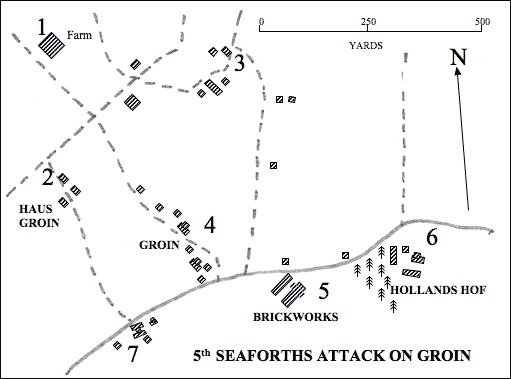
Sketch Map of Groin, March 1945
show infoDescription:
Sketch map showing key features of the attack on Groin
Tags:
"The Colonel was called to Brigade.
I went with Derek Lang of the Camerons,' he said. 'The shelling was awful, and we got caught in a stonk on the way. We grovelled in some tank tracks until it was over. They were only eight inches deep, but I'm sure we'd have been killed without them. When we reached Brigade we found the Brigadier hit but carrying on. He said: "The General's dead. But you mustn't tell anyone yet, not until this business is over." Then he told me to take Groin from the north-west after dark. Derek was to let me know when the Camerons were on their objective, and then we were to start.'
The Colonel returned; and while he was passing on the orders to the company commanders, the house in which the "0" Group was being held had a direct hit from a shell, the ceiling collapsed about their ears, and everyone emerged covered with plaster. It was not a pleasant day. We had stood a great deal and had nothing as yet to show for it. No one was sorry when, at last, the Camerons success signal came through and we could get to grips with Groin.
It was a small village of no peacetime importance set in a flat, featureless country; but it covered a main exit from Rees, and it was essential that no enemy reinforcements should reach Rees. Also, our bridgehead had to be expanded. We had to have it. Snugly tucked away in the village were our old playmates the Paraboys, prepared, as usual, to be bloody minded. The Battalion moved from its cramped position in the ditches at 0015 hours on March 25 after seventeen hours on the east bank of the Rhine. A Burning building in the factory which the 2nd Seaforth had captured acted as a beacon, and Groin too was on 'fire; but, even so, the route was difficult to follow, so tortuous was it and in places so blocked with rubble and trees. The main road was being heavily shelled by long-range guns, and we had casualties. The noise was so deafening that we could hardly hear the mattresses destined for Groin passing overhead. All round the horizon houses burned, and everywhere shells were bursting. We passed through the Camerons at 0100 hours, and advanced on the village.
The complications of this battle by firelight were many, despite the fact that the village consisted mainly of a few farms and outbuildings; and it would probably be simplest to describe only the company objectives and the times at which they were reached. Yet Groin was the hardest village fight the Battalion ever fought, and I am loathe to let it go so cheaply. The action took place in an extremely restricted area, and the village fell house by house; but if the diagram is studied in conjunction with the story, the various moves and counter-moves can be followed.
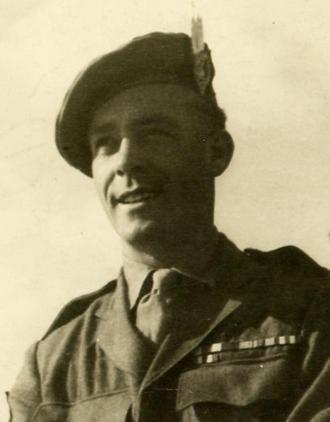
Major Hugh Robertson
show infoDescription:
This photograph of Major Hugh Robertson was sent to us by his Daughter, Linda Jane McLean, after reading Alastair Borthwick's account of the 5th Seaforth's 'Attack on Groin' in which Hugh Robertson is referred to in several sections in his role as O.C. "C" Company.
Credit:
Sent to us by Linda Jane McLean, Hugh Robertson's Daughter
Tags:
Let us consider first the situation of Hugh Robertson, O.C. "C" Company. Hugh, with "A" Company ahead of him, was trudging down the road which approached Groin from the north, being heavily shelled and mortared. Three hundred yards short of the village he bumped the tail of "A" whose first objective was a farm on the outskirts (No 1 on the diagram). The men lay waiting by the roadside while George Lisle and his platoon fought it out in the farm, and all Hugh could see were spandau flashes from the front and occasional figures running across the background of flames. His orders were to advance as soon as "A" was in the farm, so he halted his company and waited, worried by the fact that the time was 0230 hours, with little more than three hours of darkness left.
Colonel Sym arrived, and ordered "C" to advance immediately and take the right-hand group of houses (2). Hugh sent 13 Platoon under Peter Stone. When they were a hundred and fifty yards from the first house three spandaus opened up; but they managed to close, and the first house was cleared. While they were working their way down to the second one they walked into an extremely ugly concentration of spandaus and grenades, and were so badly knocked about that when Peter fell back on the first house he found he had only eight men left. There he met Hugh, who had heard the shooting and followed to find out what was happening.
'It didn't look too good,' he said. 'There we were, squatting in the back garden with one hell of a din going on, trying to get some sense out of Peter's men. They'd been badly shot up, and all I could make of it was that there were plenty Boche damn close, but no one knew quite where. I'd just decided to go back and send in 15 Platoon on a right hook, when a tattie-masher landed three yards from me and there seemed to be Boche firing from the hip all over the landscape. You know how it is when something like that happens. Time seems to stop for a bit I remember looking up and seeing men coming full belt at us about thirty yards away with muzzle-flashes coming from their middles. It all seemed to take quite a long time. They were shouting something that sounded like: "Komm! Komm!"
'Well, we didn't Komm. We went. I remember struggling through the hedge - we'd a man killed there - and then scattering back across the fields with the others to our firm base. The Boche swung too far right in the dark, and missed us .... '
First round to the Boche.
Hugh sent 15 Platoon on a right hook under Lieutenant Rhodes, but they fared no better. After a time they withdrew, minus Rhodes, who was shot through the elbow and lost in the dark. He came in later under his own steam.
Second round to the Boche.
The third round went to us, for "A" Company reached its objectives in the houses on the left (3); and the fourth was ours also. At the same time as Peter had set off on his ill-fated expedition, Hugh had sent his last platoon, No.14 under Sergeant Goldney, straight through the centre of the village to (4); and into this platoon blundered the Germans who had been chasing Peter's remnants across the fields. Goldney was ready for them; and they fled after losing three killed, one wounded, and one prisoner. Hugh, having launched everything he had, went into the village to see how Goldney was getting on.
'It was terrible,' he said. 'All the buildings were on fire. Roofs were caving in, and sparks were flying all over the place. Cattle were trapped inside. The stench sickened me. In the firelight I could see both the Boche and my own lads dodging about; and when I went down I found that Goldney had stopped short. After that he went through and beyond the buildings, and that was the last I saw of him alive. There was a lot of loose shooting, both bren and spandau, and when I got down he was lying dead on the road. They say he was shot by a German officer at close range. The rest of the boys carried on cleared all the buildings, and took up position astride the main road.
Hugh had shot his bolt. He collected the survivors of the other two platoons and sent them down to reinforce Goldney's men at (4). And that was that.
Now, if this somewhat complicated narrative has been followed, it will be evident that by this time we held the left of the village and the far end of it, but as yet had been unable to do anything about the first group of buildings at (2) where Peter Stone had been shot up. The original plan had been for "D" Company to take the buildings on the far left of the village as we looked at it (5 and 6); but now this did not look too promising. Colonel Sym left the choice to Jock Gardiner, the company commander.
'He gave me the choice of two plans,' said Jock. 'I could carry on as laid down originally, or I could go for the buildings where Hugh and Peter had had all the trouble. I decided on Hugh's buildings. It just wasn't on to go stravaiging away into the dark with a place like that still holding out behind us. And there was another thing. Whatever we did, we'd have to make it pretty quick and blitzy, because there was only an hour of darkness left. '
So "D" Company proceeded to do something pretty quick and blitzy about the building at (2), starting from Hugh's firm base at (4).
It was not a straightforward task. If the diagram is consulted again, it will be seen that (2), the strongest position yet found in the village, covered the western approaches. What more likely, reasoned Jock, than that the only other buildings facing west should also be strongly held? Before sticking his neck out in the direction of(2), he would obviously have to investigate the buildings at (7).
Sure enough, as "D" was forming up at (4), such heavy machine-gun fire began to pour from these buildings that it was only with the greatest difficulty that Jock could get his men organised. Bullets were streaming down the road, buildings were blazing and cattle groaning all around; and as dawn was already breaking, the prospect of mopping up the whole village before full daylight was becoming increasingly remote. At last 16 Platoon went forward, and the "D" Company blitz began.
The Platoon was pinned almost immediately.
'I went forward to see what was happening,' said Jock. 'Bill Manson was in terrific form in spite of the pasting he and his men were getting, but I could see there was no future in it unless we could do something else as well. The centre house was a fort, there were trenches behind it and to the flanks, and there were spandaus all over the place. Bill had had six casualties already, and it was absolutely certain that an approach from either flank was impossible. I told him to give the centre house everything he had - bren, piat, everything - while I sent 17 Platoon to work round the rear and get at the trench behind.'
Then followed something which must be described in detail, the extraordinary performance of Corporal Purchase and Gray. Lance-Corporal Green tells the story.
'We were all in No 5 section,' he said. 'There was a Corporal Purchase, and Gray was the bren gunner, and there was Hayes, and Hay and Hanson, and myself . we?d been together a long time ? right through everything- and we were all good mates. Captain Gardiner came up and called for volunteers, and Corporal Purchase says "We'll go." Captain Gardiner says: "It's important. The place must be got. " And the Corporal says: "We'll do the job properly if I have to do it myself. "
'We got 16 Platoon to put down mortar smoke and high explosive in front of us, and set off down the road. The house and the trench were on the left of the road, and that was the side where Mr. Manson was held up, so when the smoke cleared a bit and we were fired on we dived into the ditch on the right. It was a good ditch and we were able to work along it fairly fast until we hit the drain. That was the start of the business. The drain cut the ditch and the road at right angles, and a wee bridge carried the road over it; so of course that meant we couldn't crawl any farther. It meant we would have to nip out of the ditch, run across the bridge, and get back into the ditch on the far side. The Boche were only seventy yards away. They weren't fast enough to catch Purchase and Gray when they made a dive for it; but of course they were just waiting for us, and whenever we showed ourselves we got a burst through our hair.
'We thought the pair of them would wait for us and give us covering fire to help us over the gap: but nothing happened. I stood up beside a telegraph pole, and before a burst put me back into the ditch again I'd just time to see three spandaus and a hell of a lot of Boche in a big trench, and Purchase and Gray disappearing round the end of a house about forty yards away from them.
'The bullets were going through the grass a foot above our heads. We heard a bren firing, and then a sten, and we heard them shouting: "Give up, you bastards! The Seaforths are here!" That must have been when they charged. There were a few bursts of spandau, and then silence.
'We knew what that meant. They were our mates, and we were all boiled up. "To hell with this," I said. "Come on."
'We ran over the bridge, and into the ditch again, then across the road to the cover of a house, and then round to the Boche side. Purchase was lying about twenty yards from the trench, and Gray was almost inside it. There wasn't a scrap of cover for the last forty yards. The two of them had gone at it baldheaded, and there were three spandaus and forty-six men in the trench. Of course they were hit. They were hit all over. But they'd made the Boche look their way, and 16 Platoon had been able to get into the big house while the panic was on.
'We were mad when we saw them lying there. We didn't know what we were doing. We stood in the open, not even shooting, and called the Boche for all the names in creation, and yelled at them to come out. And so help me, they did. A wee white flag came over the edge, and then an officer, and then two or three, and then the whole issue. Forty-six of them. The officer was one of those right clever baskets - big smiles all over his face ....
'Purchase was the best section leader ever we had.'
He died. Gray, though he had a burst clean through him, lived to receive the Distinguished Conduct Medal and survive the war. His bren was found actually inside the German trench.
It was now daylight, and Hugh Robertson's houses at (3) were still holding out; but Bill Flynn and 18 platoon went in, hit them hard, and cleared them in half an hour. In the cellars they found Peter Stone?s wounded, and a number of Germans. The whole village was cleared by 0730.
There was a short breathing-space while the companies dug in; but their still remained Hollands Hof, and the farm at (6), which in the original plan had allotted to "D" Company and had been shelved temporarily while the fighting described on the previous few pages had been taking place. In it the Para- boys, obstinate as ever, still lingered.
The Brigadier gave Colonel Sym a free hand to take it either by day or by night. It was a difficult decision to make.
'Normally 1 should have chosen to take it at night,' the Colonel said. 'There was little cover, and the approach would have been much easier in darkness. But there was another consideration. The Germans knew that no bridges could have been erected across the Rhine in so short a time, and that we should therefore have no tanks. Yet we did have tanks. The D.D. type, equipped with canvas floats, had swum the river under their own power, and three of them had just reached us. They would be of little use at night, and in any case I reckoned that their appearance at this stage, when the German soldiers must have been told by their officers that they had nothing to fear from that direction, would have a profound effect on morale, So I decided to send "D" Company in during the afternoon, I have regretted it ever since, '
The only reasonable explanation of "D" Company's behaviour that day is that they were in a white fury at their losses of the morning. A company of infantry tended to be almost a family affair, everyone knowing everyone else; and the death or wounding of twelve men earlier in the day meant that nearly every man in the Company had lost at least one friend and was determined to make someone pay for it. They were brilliantly led and their past training must have told; but there was more to it than that. There was tenacity and recklessness in that attack which I do not think existed to quite the same degree in any other the Company fought.
The day was grey and raw, and Groin was mostly smouldering piles of rubble and blackened rafters. The Rees/Haldern road ran through it, open and bare as it emerged from the village, but with an orchard or two and a few skimpy woods farther on where Hollands Hof commanded it and stood guard over the anti-tank ditch which cut it farther on stilL From Groin to the ditch was six hundred yards, In the early afternoon three tanks began to waddle along this road with "D" Company working up the ditches on both sides of them, and Jock Gardiner walking on the road itself, behind the leading tank, talking to its commander through the telephone attached to its tail.
One of the tanks peeled off from the column, swung away right, and lay waiting on the flank like a sheep-dog while Bill Manson and 16 Platoon attacked the first houses (5), They were empty. 17 Platoon went through and continued, a row of bobbing heads in the ditches, alongside the road to Hollands Hof. Jock and his tank travelled between the two leading sections.
Hollands Hof was an old and solid place with many outbuildings, and nobody had much faith in the silence which prevailed there for the moment. Houses, especially solid houses which covered anti-tank ditches, were not, in our experience, much inclined to hospitality; and it seemed to us only a matter of time before the windows staring blindly onto the road would be empty no longer. Yet "D" Company was very close, not more than fifty yards. If the Boche were there, they had nerve to hold their fire so long. Perhaps? but that was too much to hope. Every window in Holland Hof suddenly came to life, and bullets swept down the road at almost point blank range. Simultaneously the German artillery and mortars opened up.. Within seconds, 17 Platoon?s two leading sections were wiped out.
Private Hayes says: 'I was in the section on the left of the road. We'd had a bad bashing before we started, and there were only six of us. The Boche opened up with spandaus when we were about fifty yards from the farm, and we dived for the ditch, Then Sullivan says: "Come on. Let's make a dash for it." We all got up and waded right into a burst of spandau before we were even out of the ditch. Sullivan was the first hit, but he carried on. Then he got another burst.
'I could hear Mr. Evans shouting: "Get smoke down! Get smoke down!" but there was nobody left to do it: all the boys ahead of me were hit. The tanks were firing almost on top of us, going slam, slam, slam at the house; and people were yelling and moaning. Foster, the bren gunner, was right behind me, firing bursts into the windows; but a spandau broke his gun in his hands and wounded him too. I ran back to Mr. Evans and told him there was no section left.'
Lance-Corporal Green: 'The section in the right-hand ditch got within fifteen yards, and then the Boche threw a phosphorous grenade into the middle of them and opened up with a spandau. Lowe and Betts were the only ones unwounded. One man was lying hit with his clothes covered with burning phosphorous, I could hear him yelling: "Get me out of this, get me out of this," and bullets were flying all around. Betts dragged him out and got his hands badly burned doing it. And that left only Lowe. But Mr. Evans shouts: "No one goes back till we get the wounded in." So Platoon H.Q. kept on shooting, and the stretcher-bearers went forward. There were twelve men in the two leading sections, and ten of them were lying wounded or dead in the ditches. And you should have seen the stuff that was coming out of the farm - there was a gun in every window.'
While this was going on, Jock Gardiner sent 18 Platoon under Bill Flynn to work through an orchard on the right, with the idea of turning the flank; but Bill was killed as he led them in, and his platoon was pinned by fire from a big hospital two hundred yards to the right. There were casualties; and 16 Platoon, which was in the rear, was being badly knocked about by mortaring.
Then Bill Manson was wounded. That left Jock with only one officer - Evans and a desperate situation on his hands. The mortar, artillery, and spandau fire by this time was intense, not more than half the Company was left, the Germans were still on the top of their form, and the tanks said their ammunition was running out. It was in this situation, standing on the road with the crack of the tank guns (probably the most shattering noise of the war) going on within a few feet of him and his company in ruins, that Jock Gardiner made the decision which, in the long run, won the battle. No one could have blamed him for retreating. Instead he decided to collect the remnants and make one last effort.
One tank was out of radio touch with the others, and was useless. He ordered the other two to advance up the road with him and for five minutes give Hollands Hof everything they had at point-blank range while Evans gathered the men. This was done. As the shelling stopped, Evans went in with 17 Platoon H.Q. and bits and pieces of the other two platoons , and with a supreme effort stormed the house. They fought into the rooms and the cellars; and when the last German had been killed only Evans, two NCOs and thirteen men of the Company were left on their feet.
Without a pause he collected them and made for the last centre of resistance, a big barn at the end of the farmyard. Again the spandaus opened up; and, although Evens reached the barn, he could not find the entrance. Bullets were pouring from the loopholes in the walls.
?Blow them an entrance. Knock the wall down,? jock yelled into his telephone. The tank turret swung round to the gable, the guns fired, and the walls collapsed. Evans gathered his gallant few and made for the hole.
One of the tanks peeled off from the column, swung away right, and lay waiting on the flank like a sheep-dog while Bill Manson and 16 Platoon attacked the first houses (5), They were empty. 17 Platoon went through and continued, a row of bobbing heads in the ditches, alongside the road to Hollands Hof. Jock and his tank travelled between the two leading sections.
Hollands Hof was an old and solid place with many outbuildings, and nobody had much faith in the silence which prevailed there for the moment. Houses, especially solid houses which covered anti-tank ditches, were not, in our experience, much inclined to hospitality; and it seemed to us only a matter of time before the windows staring blindly onto the road would be empty no longer. Yet "D" Company was very close, not more than fifty yards. If the Boche were there, they had nerve to hold their fire so long. Perhaps? but that was too much to hope. Every window in Holland Hof suddenly came to life, and bullets swept down the road at almost point blank range. Simultaneously the German artillery and mortars opened up.. Within seconds, 17 Platoon?s two leading sections were wiped out.
Private Hayes says: 'I was in the section on the left of the road. We'd had a bad bashing before we started, and there were only six of us. The Boche opened up with spandaus when we were about fifty yards from the farm, and we dived for the ditch, Then Sullivan says: "Come on. Let's make a dash for it." We all got up and waded right into a burst of spandau before we were even out of the ditch. Sullivan was the first hit, but he carried on. Then he got another burst.
'I could hear Mr. Evans shouting: "Get smoke down! Get smoke down!" but there was nobody left to do it: all the boys ahead of me were hit. The tanks were firing almost on top of us, going slam, slam, slam at the house; and people were yelling and moaning. Foster, the bren gunner, was right behind me, firing bursts into the windows; but a spandau broke his gun in his hands and wounded him too. I ran back to Mr. Evans and told him there was no section left.'
Lance-Corporal Green: 'The section in the right-hand ditch got within fifteen yards, and then the Boche threw a phosphorous grenade into the middle of them and opened up with a spandau. Lowe and Betts were the only ones unwounded. One man was lying hit with his clothes covered with burning phosphorous, I could hear him yelling: "Get me out of this, get me out of this," and bullets were flying all around. Betts dragged him out and got his hands badly burned doing it. And that left only Lowe. But Mr. Evans shouts: "No one goes back till we get the wounded in." So Platoon H.Q. kept on shooting, and the stretcher-bearers went forward. There were twelve men in the two leading sections, and ten of them were lying wounded or dead in the ditches. And you should have seen the stuff that was coming out of the farm - there was a gun in every window.'
While this was going on, Jock Gardiner sent 18 Platoon under Bill Flynn to work through an orchard on the right, with the idea of turning the flank; but Bill was killed as he led them in, and his platoon was pinned by fire from a big hospital two hundred yards to the right. There were casualties; and 16 Platoon, which was in the rear, was being badly knocked about by mortaring.
Then Bill Manson was wounded. That left Jock with only one officer - Evans and a desperate situation on his hands. The mortar, artillery, and spandau fire by this time was intense, not more than half the Company was left, the Germans were still on the top of their form, and the tanks said their ammunition was running out. It was in this situation, standing on the road with the crack of the tank guns (probably the most shattering noise of the war) going on within a few feet of him and his company in ruins, that Jock Gardiner made the decision which, in the long run, won the battle. No one could have blamed him for retreating. Instead he decided to collect the remnants and make one last effort.
One tank was out of radio touch with the others, and was useless. He ordered the other two to advance up the road with him and for five minutes give Hollands Hof everything they had at point-blank range while Evans gathered the men. This was done. As the shelling stopped, Evans went in with 17 Platoon H.Q. and bits and pieces of the other two platoons , and with a supreme effort stormed the house. They fought into the rooms and the cellars; and when the last German had been killed only Evans, two NCOs and thirteen men of the Company were left on their feet.
Without a pause he collected them and made for the last centre of resistance, a big barn at the end of the farmyard. Again the spandaus opened up; and, although Evens reached the barn, he could not find the entrance. Bullets were pouring from the loopholes in the walls.
?Blow them an entrance. Knock the wall down,? jock yelled into his telephone. The tank turret swung round to the gable, the guns fired, and the walls collapsed. Evans gathered his gallant few and made for the hole.
Division History References :
The Operation to cross the Rhine was to be called Operation Plunder. The Plan for Operation Plunder was to cross on a two corps front with 51st Highland division on the left leading 30 Corps. The Divisional objectives on the other side of the Rhine were Honnepel and Rees.