
Ardennes - Battle of the Bulge
December 1944 - January 1945
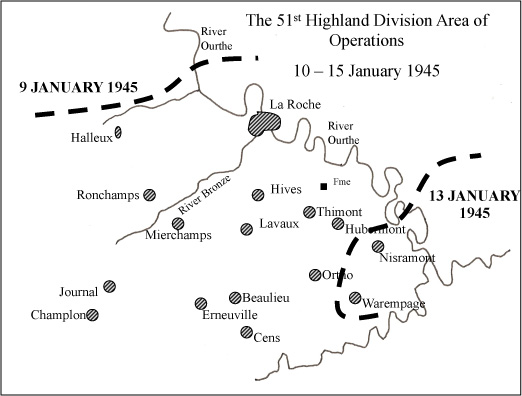
Area of Operations - Ardennes
show infoDescription:
Map detailing the Highland Division's area of operations during 10-15 January 1945 in the Ardennes.
Tags:
Just before Christmas 1944 the GOC took his commanders to carry out a reconnaissance for the next phase of operations - clearing the Germans from the River Maas to the River Rhine, which would commence in the new year. However, news of the German counter attack in the Ardennes (which became known as the Battle of the Bulge) now changed the plans and 51st Highland Division were ordered south.
On 16 December 1944 Hitler launched an offensive through the Ardennes aimed at driving a wedge between the allies, securing Antwerp and the important fuel supplies, cutting off the forces in the north and reversing the tide of the war in Germany's favour. The attack came as a complete surprise to the Allies. For this offensive, which became know as the Battle of the Bulge, Hitler assigned three armies. These were, in the north the Sixth SS Panzer Army which would attempt to break through to Liege, in the centre the Fifth Panzer Army which was to attack towards the St Vith and Bastogne, and in the south the Seventh Army directed on Luxembourg.
Determined American resistance deprived the Germans of early success and only the Seventh Army managed a breakthrough with the 1st SS Panzer Division which raced towards Malmedy, Stavelot and Liege. The offensive slowed but by 19th December the Germans were closing in on St Vith and Bastogne. Although the defenders of St Vith were forced to retreat they had inflicted a serious delay on the Germans. Meanwhile the refusal of Bastogne to surrender ( "Nuts", the US commander's reply to the request going down in history) prevented a breakout in the south.
Meanwhile on 19th December, Eisenhower cancelled the Allied offensive operations elsewhere and ordered Patton to attack the southern flank of the German salient and gave Montgomery command of additional US troops to assist his own in driving down on the northern flank of the German salient.
The US counter attack began on the 22nd December. The Allied operations had been hindered in the first week of the offensive by thick fog making air operations impossible. When this lifted on 23rd December the air superiority of the allies was a crucial in both resupplying Bastogne and in attacking the Germans.
With the German offensive now stalled the Germans concentrated on Bastogne. The Allies now pushed forward slowing driving back the retreating Germans. Hitler's Ardennes offensive was over.
After an unsatisfactory period of order and counter order over the Christmas period the Division spent a week guarding a number of the River Maas crossings between Liège and Namur before moving forward on 7th January to take over from the 53rd Welsh division prior to the allied counter offensive.
The counter offensive had began on the 3rd January but for the 51st Highland Division operations commenced on the 9th January. 153 Brigade advanced first clearing the enemy from Hodister and other villages south west of the Ourthe valley.
Ronchamps and La Roche
The counter offensive made possible the advanced of 152 Brigade on Ronchamps and 154 Brigade on La Roche. The conditions were appalling with both extreme cold and heavy snow falls
On 10th January 152 Brigade moved through 153 Brigade with the task of pushing across the Marche - La Roche road and on to take Ronchamps thus covering the right flank of the divisional advance down the Ourthe valley.
With the successful advance of 152 Brigade to Ronchamps the Divisional right flank was secure and all was ready for the assault by 154 Brigade down the Ourthe valley to La Roche.
The two positions of Ronchamps and La Roche opened the way for the Division to exploit south down a number of routes, which they did in subsequent operations over the next two days. By this stage the Germans were withdrawing and opposition was light as moping up continued. Contact was established with the US 3rd Army fighting north. All combat activity in the 30 Corps area was concluded by 15 January. The Americans continued to pursue the withdrawing Germans until the end of the month but the 51st Highland Division had completed its task and gathered in the La Roche area to begin moving back north on 17th January to recommence the drive to the River Rhine.